


Solutions
For Exporters & Importers

For Freight Forwarders and Logistics Service Providers
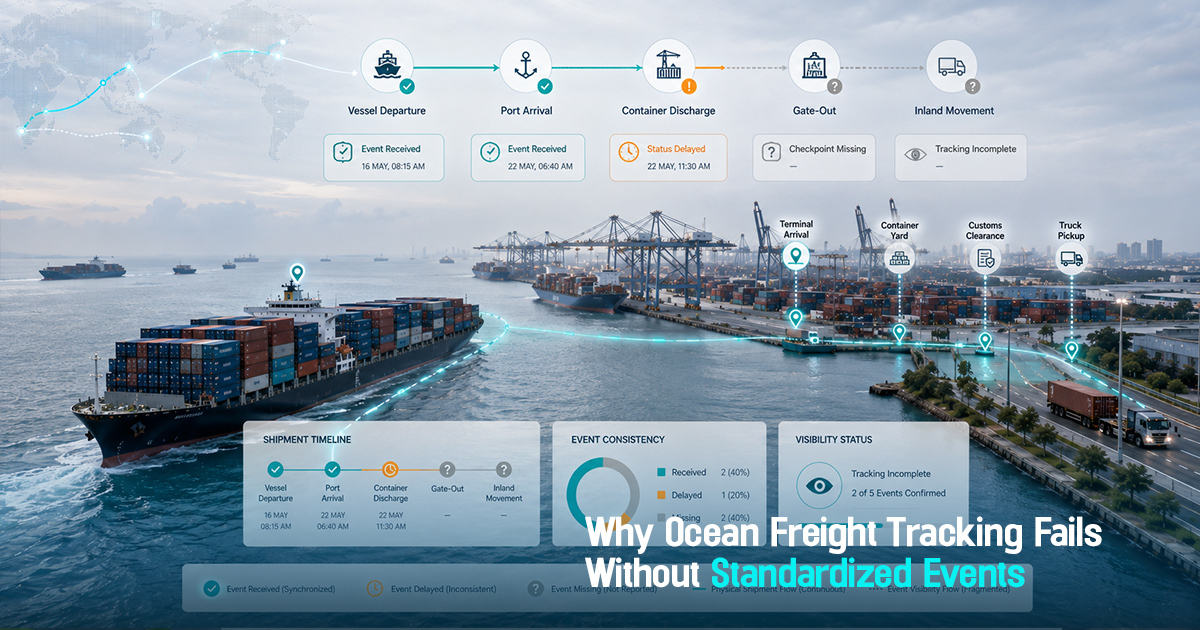
Why Ocean Freight Tracking Fails Without Standardized Events


4 Minutes
Ocean freight tracking is a crucial element in global logistics operations, enabling stakeholders to monitor shipment status, manage exceptions, and coordinate downstream processes. Operationally, accurate and timely tracking data ensures better decision-making and reduces risks of delays, demurrage, and inventory disruptions. However, ocean freight tracking often fails to deliver these benefits because of inconsistent event data formats and non-standardized tracking events across carriers and ports.
What is ocean freight tracking and why standardization matters
Ocean freight tracking refers to the process of monitoring cargo movements and shipment status updates throughout the maritime shipping journey using specific freight event data. This includes milestones like container loading, vessel departure, arrival at transshipment ports, customs clearance, and final delivery.
Without standardized tracking events, data from different carriers and terminals can vary widely in format, timing, and terminology. This inconsistency leads to fragmented visibility and operational blind spots affecting coordination, compliance, and exception management in marine logistics tracking.

Common freight tracking challenges in ocean shipments
Freight forwarders and supply chain managers face multiple issues due to inconsistent tracking, such as missing shipment status updates and delayed alerts for exceptions like detention or demurrage. Lack of uniform data also complicates vendor coordination and customer communication, increasing operational workload and risks.
These challenges stem from carriers and terminals using proprietary event codes, irregular update frequencies, or partial visibility limited to certain geographic regions. Such fragmented ocean shipment visibility undermines logistics tracking accuracy and delays timely responses to exceptions and shipment disruptions.
How standardized tracking events improve shipment visibility
Standardized tracking events are pre-defined, uniform codes and milestones recognized across carriers, terminals, and freight systems to represent shipment progress. They provide a common language for reporting cargo status, enabling centralized freight management platforms to aggregate, normalize, and analyze data seamlessly.
By establishing consistent freight event data, operations teams gain a clearer, real-time picture of shipment location, ETA, and exception status. This enhances exception handling workflows, streamlines vendor coordination, and improves customer communication with accurate and timely updates.
Standardized tracking events enable clearer visibility and faster resolution of shipping exceptions.
Practical checklist: Implementing standardized ocean freight tracking events
For freight forwarders and supply chain managers looking to improve ocean shipment visibility, use this checklist to ensure effective adoption of standardized event data:
- Identify key shipment milestones (e.g., container gate-in, vessel departure, customs clearance).
- Map carrier-specific event codes to a common industry standard like UN/CEFACT or FIATA.
- Integrate cargo tracking systems capable of normalizing diverse carrier and terminal data.
- Ensure frequent and consistent updates are pushed from all supply chain nodes.
- Train operations teams and vendors on the importance of standardized shipment status updates.
- Adopt an exception-first workflow to prioritize alerts related to detention, demurrage, or delays.
- Regularly audit tracking data quality to maintain logistics tracking accuracy.
Following these steps helps embed disciplined tracking practices that reduce blind spots and improve operational clarity throughout the shipment lifecycle.
How to navigate freight event data complexities
Freight event data complexity arises from heterogeneous systems, legacy processes, and varying regional regulations. Operations teams need a clear workflow that consolidates data inputs, validates event authenticity, and aligns event timestamps across sources.
A practical workflow involves: booking → documentation → visibility → exception handling → delivery control. Standardized events fit naturally into the visibility and exception handling phases, providing the signals that trigger follow-ups and coordinated action.
Common mistakes undermining ocean freight tracking accuracy
One frequent mistake is relying on spotty or manual updates from carriers without validation, leading to outdated or inaccurate statuses that impair exception management. Ignoring the need to map carrier-specific codes to unified standards causes data fragmentation.
Another issue is underestimating the importance of regular training and vendor communication. Teams fail to enforce discipline on timely event reporting, resulting in gaps that increase detention, demurrage, and costly operational surprises.
Choosing between manual and automated freight tracking workflows
Manual tracking processes can lead to errors, missed updates, and limited scalability, especially across multiple carriers and geographies. Automated cargo tracking systems programmed to recognize and normalize standardized events enhance accuracy and reduce operational overhead.
Automation facilitates instant access to accurate shipment status updates and flags exceptions proactively, enabling exception-first operations that focus team time where it matters most to control costs and meet service commitments.
Conclusion
Ocean freight tracking failures predominantly arise from inconsistent and non-standardized freight event data transmitted by carriers and terminals. Adopting standardized tracking events addresses this core issue by creating uniform, machine-readable status updates that improve logistics tracking accuracy, help teams handle exceptions faster, and provide transparent visibility across the shipment lifecycle. Implementing structured workflows—from booking to exception handling—with disciplined vendor communication ensures that operations teams avoid costly delays and inefficiencies such as detention and demurrage. For supply chain decision-makers and freight forwarders, prioritizing standardization is a practical step toward achieving real-time visibility and operational clarity in marine logistics. Emphasizing standardized event data also supports auditability and better risk mitigation, critical for complex global freight operations.

Get in Touch!
We'll reach out shortly with the info you need. No spam, just a helpful conversation.
Recommended Blogs
Freightstory Technologies Private Limited
A-209, Dynasty Business Park, JB Nagar,
Andheri East, Mumbai- 400059, India


For Exporters & Importers
For Freight Forwarders
© 2026 Frayto. All Rights Reserved.