


Solutions
For Exporters & Importers

For Freight Forwarders and Logistics Service Providers
Port Congestion Tracking: How It Helps Importers Plan Better


5 Minutes
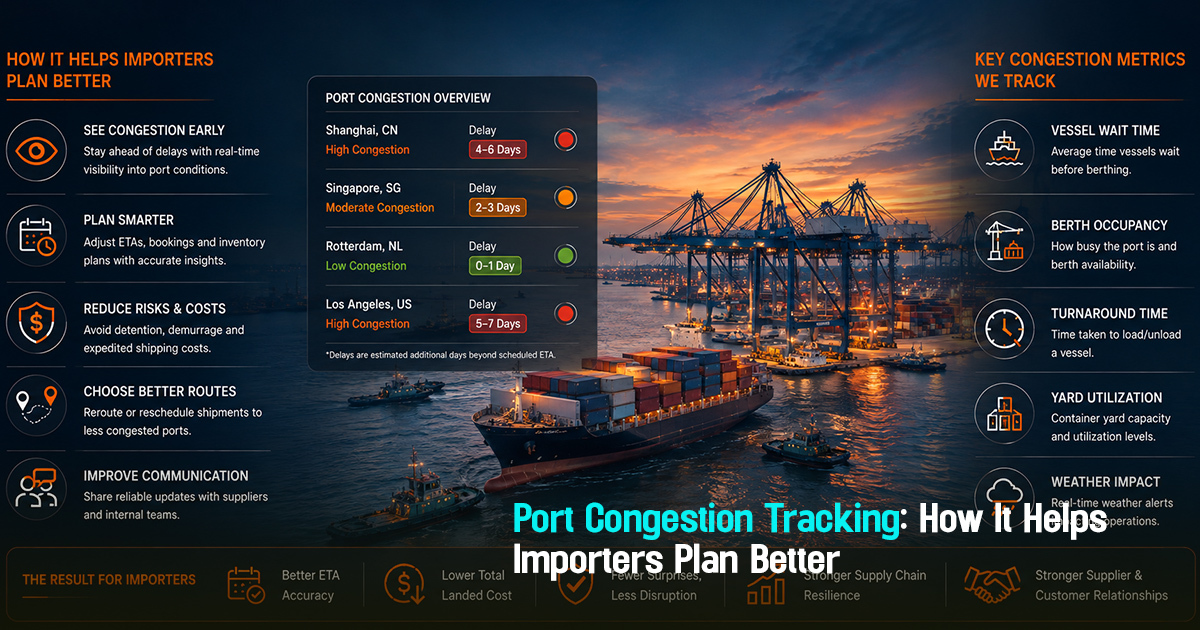
Port congestion tracking refers to the systematic monitoring and analysis of delays and bottlenecks at shipping ports that affect cargo flows. For importers, this visibility is critical because port congestion directly impacts shipment arrival times, inventory planning, and overall supply chain reliability. Without timely updates on port status, importers face last-minute disruptions, higher costs including detention and demurrage, and inefficient warehouse scheduling. This article explains the practical freight workflows, decision points, and exception management steps importers should implement to leverage port congestion tracking effectively for better shipment planning and operational clarity.
What Is Port Congestion Tracking and Why It Matters to Importers
Port congestion tracking means continuously monitoring conditions like berth availability, vessel queues, and customs processing times at ports to identify delays affecting shipments. This visibility into port bottlenecks helps importers anticipate shipment delays early and adjust downstream operations.
Without structured port congestion visibility, importers often rely on fragmented or delayed data, which leads to reactive planning. Early awareness of congestion enables proactive shipment rescheduling, better carrier communication, and mitigation of detention/demurrage risks that otherwise inflate costs.

A Practical Workflow for Port Congestion Tracking and Importer Planning
To operationalize port congestion tracking effectively, importers and logistics teams can implement the following workflow designed for clarity and action:
- 1. Real-time Congestion Monitoring: Aggregate data from port authorities, carriers, and AIS (Automatic Identification System) feeds to track vessel berth status, container yard availability, and customs queue lengths.
- 2. Shipment Impact Assessment: Analyze how current congestion affects inbound container arrival ETAs and the potential ripple on warehouse unloading and order fulfillment.
- 3. Carrier Coordination and Exception Handling: Engage carriers immediately upon detecting port delays to explore alternatives such as vessel rerouting, transshipment, or priority handling.
- 4. Shipment Rescheduling and Inventory Planning: Adjust unloading schedules and inventory replenishment plans using updated ETA information and delay forecasts.
- 5. Customer Communication and Documentation Updates: Notify internal stakeholders and customers proactively about potential delays and adjust documentation to reflect revised timelines.
- 6. Detention and Demurrage Risk Management: Monitor free time expiry and detention charges, coordinating early intervention to minimize avoidable costs.
- 7. Continuous Feedback and Audit: Log congestion events, decisions taken, and outcomes for future benchmarking and improving operational discipline.
Role-Wise Priorities in Port Congestion Tracking for Import Operations
Freight forwarders must focus on consolidating carrier data and port updates, assigning clear ownership for follow-ups, and ensuring updated shipment milestones.
Importers need to monitor port congestion impact on ETA and plan warehouse resources and order schedules accordingly, while verifying cost implications.
Operations teams should track port milestone updates daily and handle exceptions triggered by congestion, such as delays in customs clearance or delivery.
Procurement teams can use congestion data to make informed decisions on carrier selection, understanding which ports cause recurrent delays and negotiating terms.
Documentation teams must anticipate adjustments in arrival dates, ensuring all import permits, customs documents, and invoices reflect revised schedules to avoid clearance bottlenecks.
Implementation Stages: Port Congestion Tracking Before, During, and After Shipment
Before Shipment: Validate port capacity and expected congestion based on recent data; factor potential delays into shipment scheduling and procurement approvals.
During Transit: Monitor updated ETDs and ETAs closely; use centralized tracking dashboards to identify emerging congestion and trigger exception workflows for carriers and internal teams.
After Arrival: Confirm vessel berthing and container discharge milestones; update inventory and customer systems; review detention billing and congestion impact on supply chain KPIs.
Concrete Examples of Port Congestion Impact on Import Shipment Planning
Example 1: An importer faced sudden congestion at a major East Coast port with vessels queued for three days. Early congestion tracking allowed the freight forwarder to re-route urgent shipments via a neighboring port, minimizing unloading delay.
Example 2: Without real-time port data, an importer experienced unplanned detention charges when delayed customs clearance was not anticipated due to congestion-related staffing shortages, inflating landed costs.
Example 3: A logistics team integrated port congestion signals with shipment visibility, enabling operational teams to adjust warehouse labor schedules dynamically, avoiding resource idling and improving cost efficiency.
Early port congestion visibility transforms reactive delays into proactive shipment planning and operational control.
Practical checklist
For effective port congestion tracking and importer shipment planning, logistics teams should check these:
- Are port congestion data sources integrated into your shipment tracking system for real-time alerts?
- Are vessel queue lengths and berth availability monitored daily for key import ports?
- Is there a designated owner responsible for carrier coordination when port congestion impacts ETA?
- Are shipment schedules adjusted promptly based on congestion-induced delays?
- Are detention and demurrage timelines tracked to initiate proactive negotiations?
- Do documentation teams update customs paperwork timelines according to new ETAs?
- Are customer-facing updates communicated early and clearly about port delays?
- Is congestion impact logged systematically for operational reviews and vendor negotiations?
- Are contingency plans defined for congestion scenarios, including alternative ports or transport modes?
- Is congestion data used in freight procurement decisions to select resilient carriers and routes?

Common mistakes
Ignoring Early Congestion Signals: Many teams fail to track port congestion until a delay disrupts operations, leading to reactive chaos. Fix by integrating real-time port data feeds and assigning ownership for early detection.
Fragmented Communication: Delayed or siloed updates among carriers, operations, and customers increase confusion and escalation risk. Fix by centralizing shipment visibility and enforcing exception-first communication workflows.
Overlooking Detention and Demurrage Risks: Missing congestion-related cost exposures inflates landed costs unexpectedly. Fix by integrating detention tracking with congestion data and alerting responsible teams before charges accrue.
Reactive Inventory Planning: Failure to adjust warehouse schedules based on updated ETAs causes inefficiency and excess cost. Fix by connecting congestion insights directly to inventory and labor planning systems.
Manual Tracking and Follow-Ups: Relying on manual checks increases errors and effort in understanding port congestion effects. Fix by adopting automated centralized dashboards that aggregate carrier and port status in one view.
A Frayto-Aligned Port Congestion Tracking Workflow
The Frayto operational approach to port congestion tracking prioritizes a structured sequence: Data Integration → Congestion Impact Analysis → Exception Flagging → Carrier Coordination → Rescheduling → Customer Updates → Detention Risk Monitoring. Each step relies on centralized shipment visibility, automated milestone tracking, and clear exception ownership to maintain control over shipment outcomes despite port delays. This approach reduces manual follow-ups and ensures timely communication across teams and customers, protecting supply chain integrity and costs.
Frequently Asked Questions
Get in Touch!
We'll reach out shortly with the info you need. No spam, just a helpful conversation.


For Exporters & Importers
For Freight Forwarders
© 2026 Frayto. All Rights Reserved.