


Solutions
For Exporters & Importers

For Freight Forwarders and Logistics Service Providers
Freight Audit and Invoice Dispute Management: How Visibility Helps


6 Minutes
Freight audit and invoice dispute management is a critical process in logistics operations that ensures freight costs are accurate, transparent, and verifiable. Operationally, it matters because unchecked freight billing errors can lead to unexpected costs, delayed payments, and strained vendor relationships. Ineffective dispute resolution prolongs payment cycles and hides root causes of shipment delays or inefficiencies. This article explores how visibility in freight operations directly supports effective freight audit and dispute workflows to reduce costs and improve trust across stakeholders.
What is Freight Audit and Invoice Dispute Management?
Freight audit and invoice dispute management is the workflow of verifying freight invoices against agreed contracts, shipment milestones, and service levels to identify discrepancies, resolve disputes, and ensure cost accuracy. It involves systematic logistics invoice verification supported by comprehensive shipment visibility to track ETA/ETD and documented exceptions.
At its core, this process protects shippers and forwarders from paying incorrect charges such as duplicate fees, unagreed surcharges, or billing for unexecuted services. It also underpins financial controls and audit readiness in logistics operations by providing transparent, verifiable data flows.
A Practical Workflow Framework for Freight Audit and Dispute Management
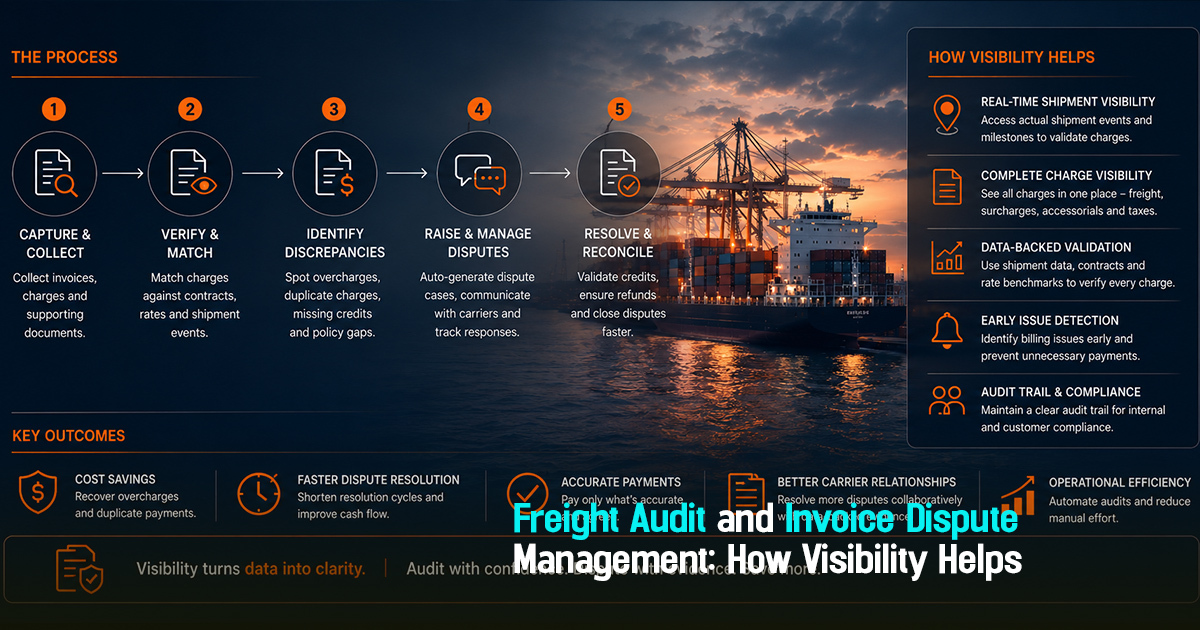
Implementing freight audit and invoice dispute management requires a structured workflow connecting operational data, cost verification, and resolution steps. Here is a 6-point practical workflow:
- Invoice Receipt and Matching: Collect freight invoices and automatically match them against contracted rates and shipment data.
- Data Validation with Shipment Visibility: Cross-check milestone timestamps, ETD/ETA, and exception reports against the invoice line items.
- Exception Identification: Flag any discrepancies such as rate mismatches, extra charges, or missing services for review.
- Root Cause Review: Work with operations, carriers, and vendors to quickly diagnose issues like delays, re-routing costs, or documentation gaps.
- Dispute Resolution and Collaboration: Initiate structured communication channels for swift resolution backed with documented evidence.
- Audit Documentation and Closure: Record all decisions, approvals, and communications to maintain audit trails and financial control.
This framework reduces manual effort, speeds up dispute handling, and improves cost control by tying invoice verification to real shipment events, enabling higher accuracy and accountability.

Role-Wise Responsibilities in Freight Audit and Dispute Workflows
Freight forwarders coordinate carrier communications and provide evidence such as BLs and milestone confirmations during disputes. They must ensure timely sharing of shipment event data for invoice matching.
Importers and exporters monitor shipment milestones, review freight charges passed on via forwarders, and flag anomalies early. Their proactive oversight helps reduce surprise billing issues.
Operations teams track shipment execution closely, report ETA/ETD changes, and note exceptions affecting costs, such as demurrage or detention charges. Their accurate milestone logging underpins invoice accuracy.
Procurement and finance teams validate freight rates, confirm quote approvals, and own the final payment decision. Their discipline in approval and audit controls prevents unauthorized charges from slipping through.
Documentation and customer service teams support audits by providing paperwork, customer communications, and clarification on service scope. They hand off validated shipping documents to support dispute resolution.
How Freight Visibility Enhances Freight Audit and Invoice Processing
Visibility in freight operations creates a single source of truth by aggregating shipment tracking, ETA monitoring, and exception handling data. This structured operational clarity prevents invoice disputes caused by hidden detention fees or missed milestones.
For example, if a container experiences an unplanned demurrage event due to a customs delay, visibility tools record the exception with timestamps. This data is essential to justify or dispute related freight charges during audit, streamlining resolution workflows.
Freight Audit and Invoice Dispute Management: A Before, During, and After Shipment Breakdown
Before Shipment, validate contracts and agreed freight rates to ensure the baseline invoice expectations are clear and auditable.
During Shipment, track milestones, ETD/ETA, and exception flags closely. Confirm events such as vessel arrival, customs clearance, delivery instructions, and container handoffs to capture all operational details affecting cost.
After Delivery, collect all shipment documents, reconcile freight invoices against contract terms and shipment visibility data, and proactively identify anomalies or disputes for resolution before payment.
Practical checklist
Use this checklist to ensure freight audit and dispute management is structured and efficient across shipments:
- Have all freight invoices been matched line-by-line against contract rates and shipment events?
- Are ETD/ETA and milestones verified and timestamped for each shipment in the system?
- Is there a centralized log of exceptions such as detention, demurrage, or re-route charges?
- Are all dispute queries raised with vendors documented with supporting data?
- Is there clear ownership for resolving each invoice dispute within the team?
- Are dispute resolution deadlines tracked to avoid delayed payments or penalties?
- Are approval workflows for freight payments strictly followed and audited?
- Is customer communication proactive for disputed charges related to shipment delays or issues?
- Are documents such as Bills of Lading and delivery receipts systematically archived for audit?
- Are lessons from recurring invoice disputes used to improve contracting or operational workflows?
Visibility into shipment milestones and exceptions turns invoice disputes into actionable resolutions.
Common mistakes in Freight Audit and Invoice Dispute Management
Reactive Invoice Processing: Waiting until invoice receipt to check rates leads to missed cost-control opportunities. Fix: Implement pre-shipment contract and rate validation with visibility into execution.
Lack of Centralized Shipment Visibility: Fragmented data from multiple carriers causes missed exceptions or milestones. Fix: Use centralized visibility platforms aggregating all carrier data for audit.
Unclear Ownership of Disputes: Disputes languish without clear team accountability, delaying resolution. Fix: Assign specific owners for all disputes with tracked deadlines.
Poor Documentation Management: Missing shipping and transactional documents hinders proof during disputes. Fix: Enforce disciplined documentation handoffs and archive access.
Ignoring Operational Exceptions: Demurrage or detention costs ignored until invoice stage cause unexpected charges. Fix: Integrate exception handling into audit with proactive alerts.
Poor Communication with Vendors and Customers: Delayed or unclear communication deepens disputes and risks relationships. Fix: Maintain a proactive communication strategy updated by shipment visibility data.
Frayto-Aligned Freight Audit and Invoice Dispute Workflow
A typical structured workflow in systems aligned with Frayto’s approach runs as: Rate Request → Vendor Comparison → Approval → Booking → Shipment Tracking → Exception Handling → Freight Audit and Invoice Dispute Closure. This ensures continuous visibility of cost implications from procurement through execution, allowing timely detection of billing mismatches tied to shipment events.
By linking shipment tracking data and exceptions directly to invoice line items, teams gain clarity and faster dispute resolution. Ownership of each dispute is clear, and decisions are supported by structured documentation and milestone verification.

Concrete examples of visibility improving freight audit outcomes
1. An importer identified a wrongful detention charge because shipment visibility recorded a customs delay with timestamps, providing evidence to dispute the cost successfully.
2. A freight forwarder reconciled an ocean freight invoice faster by using a centralized tracking dashboard that clearly showed deviation in vessel ETAs, explaining surcharges during transit.
3. A procurement team avoided duplicate billing by comparing vendor invoices against approved rate cards and documented shipping milestones, catching an overcharge related to rerouted cargo.
FAQ
Get in Touch!
We'll reach out shortly with the info you need. No spam, just a helpful conversation.


For Exporters & Importers
For Freight Forwarders
© 2026 Frayto. All Rights Reserved.