


Solutions
For Exporters & Importers

For Freight Forwarders and Logistics Service Providers
MSC Container Tracking: How to Reduce Manual Portal Checks for Better Freight Visibility


7 Minutes
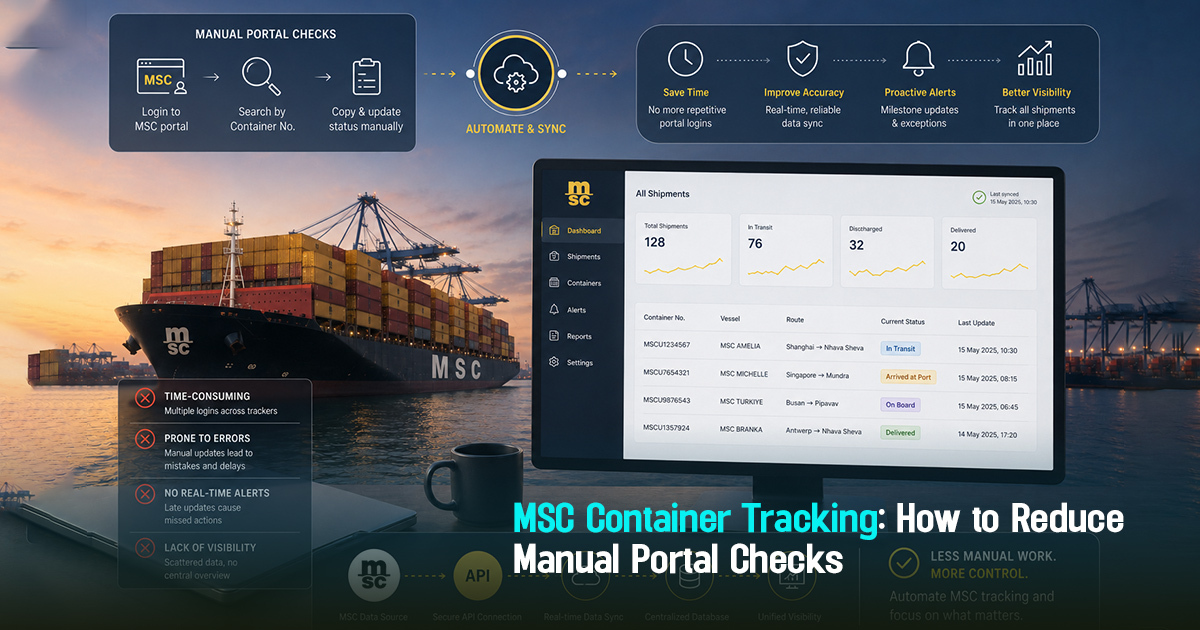
MSC container tracking refers to the process of monitoring shipping containers handled by the Mediterranean Shipping Company through their official tracking portals and systems. Operationally, relying heavily on manual portal checks for MSC containers creates inefficiencies such as delayed updates, missed exceptions, and scattered information across multiple carriers—hindering freight visibility. This article offers a practical approach to reducing manual MSC container tracking checks by adopting structured and automated workflows that improve tracking accuracy, reduce follow-ups, and provide centralized shipment visibility for freight forwarders, importers, exporters, and logistics managers.
What is MSC Container Tracking and Why It Matters for Freight Visibility
MSC container tracking is the real-time monitoring of container movements and status updates provided by Mediterranean Shipping Company through its tracking portals. Accurate tracking ensures visibility into key milestones such as vessel loading, departure, transshipment, arrival, and delivery. Without this, logistics teams struggle with shipment uncertainties and costly delays.
Manual tracking on MSC’s portal often leads to operational blind spots—teams miss ETA changes, exceptions pile up unnoticed, and customer updates lag. Efficient freight visibility requires automating tracking processes and consolidating information to reduce dependency on repetitive portal checks and email inquiries. This directly supports timely decision-making and exception handling.

A Practical Workflow for Reducing Manual MSC Container Tracking Checks
To minimize manual portal checks and enhance shipment visibility, freight teams can adopt a structured workflow. This workflow integrates automation, exception-first monitoring, and centralized updates to reduce operational burden.
The workflow consists of the following steps: Rate Request → Booking Confirmation → Centralized Tracking → Automated Milestone Updates → Exception Detection and Owner Assignment → Proactive Customer Communication → Delivery Confirmation. Each step builds on the previous, ensuring that tracking is not reactive but part of a controlled process.
Step 1: Rate Request and Booking Confirmation
Before shipment tracking even begins, freight procurement teams secure MSC container bookings with rate confirmation, ensuring the carrier and container details are correctly captured. Correct container numbers and booking references are foundational for accurate tracking and must be validated early to avoid later search errors in portals.
A proven practice is to cross-verify MSC booking numbers against freight contracts and to standardize vendor data input into systems, reducing manual errors that lead to tracking mismatches.
Step 2: Centralized Shipment Tracking
Instead of manually logging onto multiple MSC portals, teams centralize container information into one system or dashboard. Centralized tracking aggregates container events from MSC’s portal and other carrier sources, reducing manual checks and providing one source of truth for shipment status and ETAs.
For example, a freight forwarder handling multiple MSC shipments can extract container numbers and automatically pull updates via API integrations or scheduled data imports, eliminating the repetitive portal login and search process. This approach reduces operational overhead and streamlines milestone monitoring.
Step 3: Automated Milestone Updates and Exception Detection
Automating milestone updates from MSC containers allows logistics teams to track events like loading, sailing, arrival, and customs release without manual intervention. Exception-first workflows highlight deviations such as late arrivals or transshipment misses, prompting faster follow-ups.
For operational clarity, assigning owners for each exception ensures accountability. For instance, if an MSC container is delayed at a port, the assigned operations lead immediately initiates carrier follow-up and customer communication, mitigating risks of detention or demurrage charges.
Step 4: Proactive Customer Communication
Customer service teams use the tracked data to provide timely shipment status updates based on automated alerts rather than on-demand manual checks. Proactive updates reduce inbound queries and improve customer trust by providing decision-ready information ahead of escalations.
An importer tracking MSC containers, for example, benefits when the freight forwarder alerts them about ETA changes due to vessel delays, allowing them to plan customs and delivery accordingly. This reduces last-minute surprises and operational pressure.
Centralized tracking and exception ownership empower teams to reduce manual portal checks and speed operational decisions.
Role-Wise Responsibilities in MSC Container Tracking
Freight Forwarders: Coordinate bookings with MSC, ensure container details are accurate, and centralize tracking data to reduce portal logins. They must assign ownership for exceptions promptly.
Importers and Exporters: Monitor key ETAs and vessel schedules, request proactive updates, and prepare documentation early based on tracked milestones to avoid customs delays.
Operations Teams: Track active containers daily via consolidated dashboards, review milestone status, identify exceptions early, and manage carrier follow-ups to prevent detention charges.
Procurement and Documentation Teams: Validate container and booking data accuracy before booking and ensure shipment documents are linked to tracked containers for audit readiness and customs clearance efficiency.
Stage-Wise Breakdown: Before, During, and After MSC Container Transit
Before Transit: Confirm container and booking numbers with MSC, input data into centralized tracking system, validate that all shipment documents are uploaded, and set automated alerts for key milestones.
During Transit: Monitor container milestones such as gate-in, vessel loading, sailing, transshipment, and expected arrival. Use automated exception detection to flag ETA shifts or missed milestones for prompt carrier coordination.
After Arrival: Track customs clearance events, container pick-up or delivery, and confirm final container release. Close the shipment tracking workflow with a delivery confirmation and update vendor performance records.
Practical checklist
Use this checklist to reduce manual MSC container tracking and enhance shipment visibility:
- Have all MSC booking and container numbers standardized and validated before shipment tracking begins.
- Centralize MSC container tracking data in one dashboard or platform to avoid multiple portal logins.
- Set up automated milestone update feeds from MSC’s tracking system to capture real-time container events.
- Implement exception-first workflows where late ETAs or missed milestones trigger immediate alerts.
- Assign clear ownership for tracking exceptions and carrier follow-ups to avoid response delays.
- Provide proactive customer updates based on milestone alerts rather than reactive manual queries.
- Integrate container tracking data with shipment documentation to ensure audit readiness and customs clearance.
- Review completed shipment records to evaluate MSC carrier performance and identify recurring tracking gaps.
- Train teams on centralized tracking tools and exception management to improve discipline and reduce follow-ups.
- Continuously assess tracking accuracy and bottlenecks to refine automated shipment monitoring processes.

Common mistakes in MSC container tracking and how to fix them
Mistake 1: Relying solely on manual portal checks causes delays in milestone detection and missed ETA updates. Fix: Automate data capture through APIs or scheduled imports for real-time alerts.
Mistake 2: Inconsistent or incorrect container numbers entered at booking lead to tracking failures and dispersed information. Fix: Enforce booking data validation and standard formats before shipment execution.
Mistake 3: No clear ownership of tracking exceptions results in slow carrier follow-ups and undetected delays. Fix: Assign owners per shipment or container to manage and close exceptions fast.
Mistake 4: Customer updates triggered only after escalation cause dissatisfaction and inquiries. Fix: Set automated alerts that initiate proactive customer communication on ETS/ETA changes.
Mistake 5: Fragmented tracking across multiple carriers and tools makes consolidated shipment visibility impossible. Fix: Integrate MSC tracking with other carrier data in one platform for unified monitoring.
Mistake 6: Poor linkage of shipment documentation to container tracking risks customs delays and audit issues. Fix: Align document workflows with container status and ensure timely handoffs.
Frayto-aligned workflow for efficient MSC container tracking
A practical workflow aligned with Frayto’s approach emphasizes structured procurement, centralized shipment visibility, and exception-first operations. Start with procurement validation to lock in correct MSC container numbers, progress to centralized tracking with automated milestone and ETA updates, assign clear exception owners for any delays or disruptions, and conclude with proactive customer communication and documentation handoff. This cycle ensures transparency and control, reducing manual portal checks and improving operational clarity.
Teams implementing such workflows see improved shipment visibility, fewer manual follow-ups, and better decision readiness to handle MSC container operations without guesswork or scattered data.
Common freight operations examples highlighting MSC container tracking challenges
Example 1: An exporter manually checks MSC’s portal multiple times daily but misses a critical transshipment delay. Without automated alerts, the operations team informs the customer late, resulting in delivery disruptions.
Example 2: A freight forwarder managing dozens of MSC containers struggles with multiple portal logins and fragmented tracking tools, leading to inconsistent milestone reporting and customer confusion.
Example 3: Import documentation teams receive container arrival details late because manual portal checks were infrequent. This causes clearance delays and detention fees, which an automated tracking and notification workflow could have prevented.
Conclusion
Reducing manual MSC container tracking checks through centralized, automated workflows is essential for achieving operational clarity and maintaining continuous shipment visibility. By standardizing booking data, consolidating container event tracking, and implementing exception-first systems, logistics teams can focus on proactive decision-making instead of repetitive portal logins. This structured approach not only minimizes the risk of missed ETAs and costly delays such as detention, but also enhances customer communication and audit readiness. Ultimately, freight forwarders, importers, exporters, and operations managers who adopt such disciplined MSC tracking workflows will experience smoother shipment execution, reduced manual effort, and improved trust with partners and customers.
Get in Touch!
We'll reach out shortly with the info you need. No spam, just a helpful conversation.
Recommended Blogs
Freightstory Technologies Private Limited
A-209, Dynasty Business Park, JB Nagar,
Andheri East, Mumbai- 400059, India


For Exporters & Importers
For Freight Forwarders
© 2026 Frayto. All Rights Reserved.