


Solutions
For Exporters & Importers

For Freight Forwarders and Logistics Service Providers
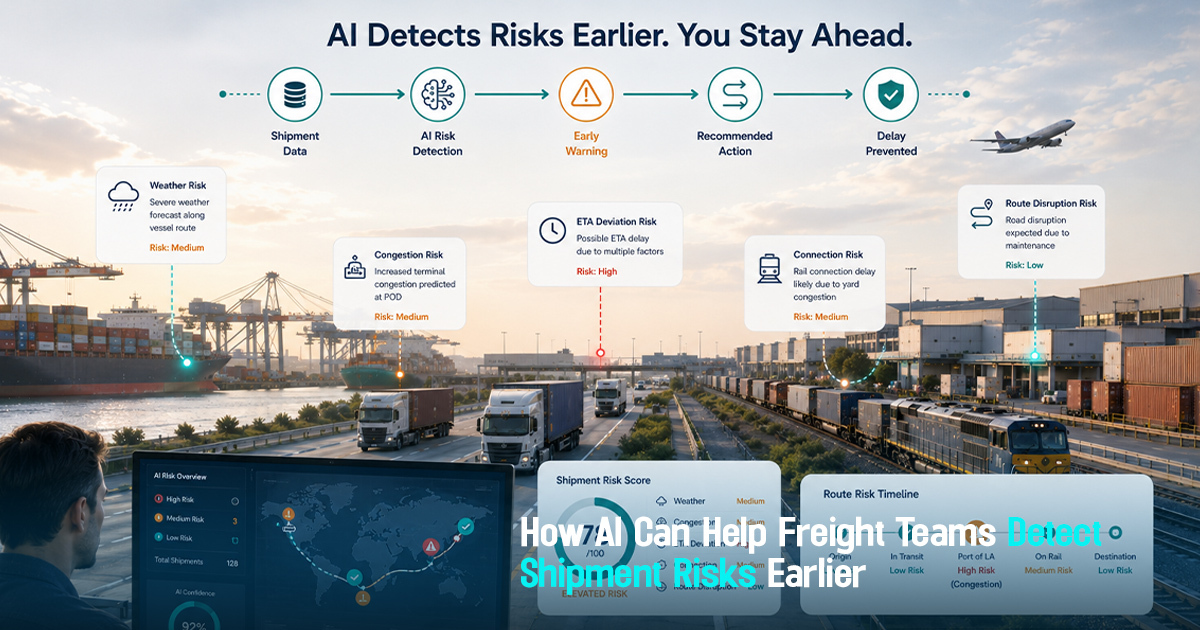
How Shipment Risk Detection with AI Can Improve Freight Operations


4 Minutes
Shipment risk detection with AI is transforming how freight teams manage and mitigate risks before they escalate into costly delays or exceptions. For operations teams handling freight procurement, tracking, and visibility, early identification of shipment risks is critical to maintaining control over complex supply chains. Yet, many teams still rely heavily on manual monitoring or reactive approaches, which limit their ability to respond promptly to emerging issues. AI offers a practical path to identify potential shipment disruptions earlier, improving decision timing and operational clarity.
What is shipment risk detection with AI?
Shipment risk detection with AI uses machine learning algorithms and data analytics to identify patterns and anomalies in freight operations that indicate upcoming delays, damage, compliance issues, or documentation errors. These insights emerge from real-time data such as carrier schedules, weather, port activity, and transport conditions.
By analyzing multiple data sources, AI-powered tools provide early warning signals that help freight forwarders and supply chain managers take corrective actions before shipment exceptions disrupt operations. This shifts teams from reactive to proactive management, a key advantage in managing global freight flows.

The operational impact of early shipment risk identification
Detecting shipment risks early reduces unforeseen disruptions such as delayed ETDs/ETAs, customs hold-ups, or carrier demurrage charges. Operational teams gain visibility into potential bottlenecks and can coordinate timely interventions such as booking adjustments, document validation, or vendor follow-up. Effective risk detection minimizes costly detention and demurrage fees and reduces reactive firefighting.
Freight procurement and operations teams equipped with AI insights can also benchmark risks across carriers and routes, supporting informed vendor selection and contract negotiations. Additionally, shipment delay prediction helps schedule internal resources better and improves customer communication, raising service reliability.
How AI-powered shipment monitoring works in practice
AI shipment monitoring typically integrates multiple data streams: GPS tracking, carrier ETAs, port congestion metrics, weather forecasts, and customs clearance statuses. Machine learning models then analyze this data for anomalies such as unusual route deviations, slowdowns, or paperwork delays. These models improve over time as they learn from new data and shipment outcomes.
Operations teams receive alerts on high-risk shipments, enabling targeted exception handling workflows. With a centralized freight management platform, teams maintain audit trails of decisions and communications, enhancing compliance and accountability.
Realistic workflow: From booking to risk mitigation
An effective workflow for shipment risk detection with AI spans critical stages:
- Booking: Input accurate shipment details and planned routes to enable relevant data capture.
- Documentation: Monitor customs and compliance documents electronically for timely approvals.
- Visibility: Use real-time tracking and AI monitoring to detect deviations or delays.
- Exception Handling: Prioritize shipments flagged by AI for immediate vendor or carrier follow-up.
- Delivery Control: Ensure updated ETAs and manage final-mile coordination based on risk insights.
Following a structured, exception-first workflow improves operational clarity and supports timely decisions that mitigate risks and cost impacts.
Early AI detection shifts freight teams from firefighting to proactive, targeted exception management.
Practical checklist
To implement shipment risk detection with AI effectively, freight teams should:
- Ensure comprehensive data integration from carriers, ports, and customs systems.
- Validate data quality regularly to maintain accurate real-time monitoring.
- Define risk thresholds for alerts to prioritize high-impact shipments.
- Establish clear workflows for exception handling tied to AI alerts.
- Train operations staff on interpreting AI insights and decision protocols.
- Review and adjust AI models regularly based on shipment outcomes and changing trade conditions.
- Maintain transparent communication with customers and vendors about risk mitigation steps.
Common mistakes
Missteps in applying AI for shipment risk detection often arise from data gaps, over-alerting, or ill-defined workflows. Ignoring data validation or relying solely on historical patterns can cause false positives or missed risks. Lack of coordination between procurement, operations, and carriers undermines responsiveness.
Overwhelming teams with notifications without clear prioritization leads to alert fatigue and delayed action. Failing to integrate AI insights into centralized freight management platforms can fragment workflows and reduce auditability, impacting compliance discipline.
Integrating with advanced shipment visibility solutions
AI-enabled shipment risk detection works best when embedded within advanced shipment visibility solutions that unify status data, documentation, and communication. These platforms enable a centralized view of shipment milestones paired with AI insights for risk prioritization.
Such integration streamlines carrier coordination and exception workflows, accelerating follow-ups and minimizing delays. Teams gain real-time freight tracking paired with actionable alerts, which enhances overall logistics risk mitigation and operational control.
Conclusion
Shipment risk detection with AI represents a practical advancement for freight teams aiming to increase visibility and reduce disruptions. By leveraging machine learning to analyze diverse data sources in real time, teams gain early insights that enable targeted exception handling and better communication with carriers and customers. Implementing this requires a disciplined approach to data integration, consistent workflow design, and regular model refinement. The result is a more resilient logistics operation that minimizes costly delays, improves compliance management, and strengthens vendor coordination. For freight forwarders and supply chain managers focused on operational clarity and cost control, embedding AI-driven shipment risk detection within centralized platforms offers a crucial step toward smarter, more proactive freight management in an increasingly complex environment. Ensuring teams understand AI insights and execute exception-first workflows remains essential to realize the full benefit of these tools.

Get in Touch!
We'll reach out shortly with the info you need. No spam, just a helpful conversation.
Recommended Blogs
Freightstory Technologies Private Limited
A-209, Dynasty Business Park, JB Nagar,
Andheri East, Mumbai- 400059, India


For Exporters & Importers
For Freight Forwarders
© 2026 Frayto. All Rights Reserved.