


Solutions
For Exporters & Importers

For Freight Forwarders and Logistics Service Providers
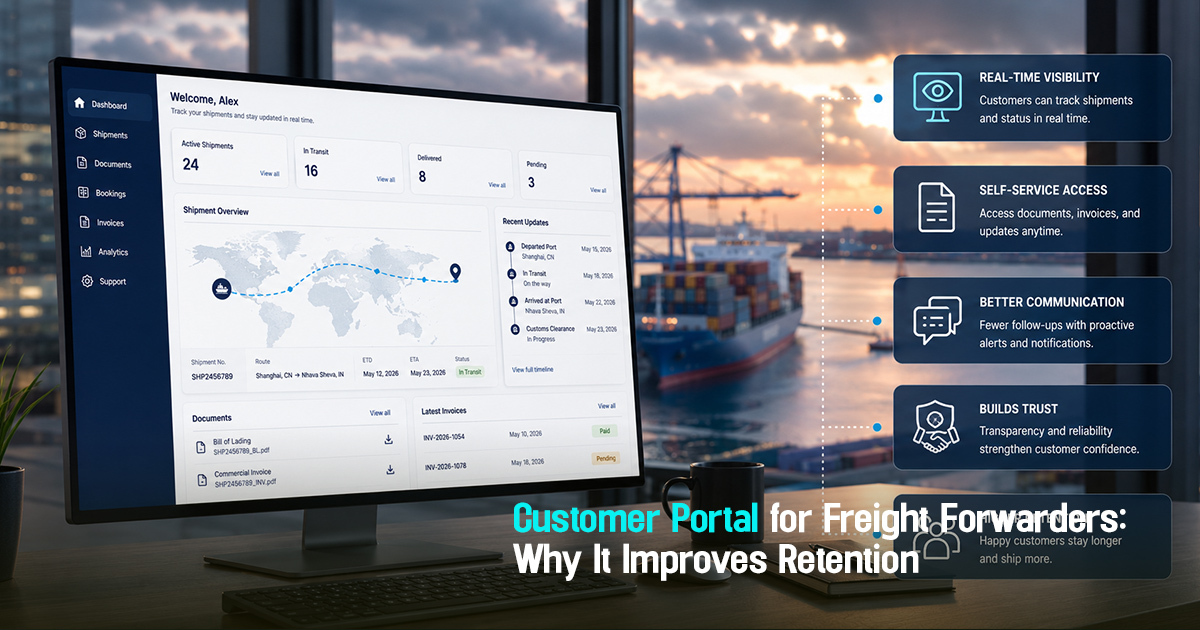
Customer Portal for Freight Forwarders: Why It Improves Retention


6 Minutes
A customer portal for freight forwarders is a centralized online platform that provides clients with real-time access to shipment status, documentation, and communication. Operationally, it matters because it reduces manual follow-ups, strengthens transparency, and builds trust—critical factors in improving freight forwarding customer retention. By addressing frequent issues like delayed updates and lack of visibility, the portal transforms client management from reactive to proactive. This article explores the practical benefits and workflows that make customer portals essential tools for freight forwarders seeking better retention and service quality.
What is a Customer Portal for Freight Forwarders?
A customer portal for freight forwarders is a digital tool that enables clients to track shipments, access documents, and view status updates in real time through a single, centralized interface. This visibility-first platform eliminates fragmented communication channels and provides operational clarity.
By consolidating shipment milestones, ETD/ETA changes, exception alerts, and documentation in one place, the portal streamlines vendor coordination and reduces customer service burden. The resulting transparency improves trust and retention, while operational teams gain a tool for structured communication and exception handling.

Why Freight Forwarders Need a Customer Portal for Better Retention
Freight forwarding customer retention hinges on consistent, timely communication and shipment visibility. Manual status updates, scattered emails, and delayed exception notifications cause frustration and weaken client relationships. A customer portal addresses these pain points by providing clients on-demand access to shipment data, reducing ambiguity and the need for follow-ups.
Operationally, this shifts freight teams from firefighting to exception-first workflows, where only deviations trigger alerts and communications. Clients appreciate transparent, reliable updates, which reinforce the forwarder's credibility and ultimately improve retention.
A Practical Workflow Framework for Customer Portal Use
Implementing and optimizing a customer portal involves a structured workflow with these seven key steps:
- Booking Integration: Link shipment bookings to the portal to enable real-time data flow, including forwarding confirmations and vendor assignments.
- Milestone Tracking: Update shipment progress with ETA, ETD, customs checkpoints, and transport events to keep clients informed.
- Exception Monitoring: Automatically flag delays, missing documents, or route changes, assigning ownership for timely resolution.
- Documentation Access: Centralize document uploads, validations, and handoffs, reducing delays and improving compliance visibility.
- Proactive Customer Updates: Push automated, exception-driven notifications to clients before they ask, reducing inbound queries.
- Feedback Capture: Enable clients to provide shipment feedback, making service issues visible and actionable.
- Audit and Reporting: Maintain logs of all updates, approvals, and communications for operational clarity and dispute resolution.
This framework guides freight forwarders in moving from fragmented updates to a proactive, data-driven client communication model, strengthening relationships through structured operational control.
Role-Wise Benefits and Responsibilities
Freight Forwarders: Coordinate carrier data integration, ensure timely milestone and exception updates, and manage document uploads. The portal reduces manual status calls and speeds exception handling.
Importers and Exporters: Monitor shipment status, ETD/ETA changes, and access customs and shipping documents instantly. This empowers timely decision-making on cargo arrival and clearance planning.
Operations Teams: Track shipment progress centrally and manage exceptions through an ownership-based system. They can also push notifications and manage customer communication schedules.
Procurement and Documentation Teams: Validate vendor rates linked to booking details inside the portal, track compliance documentation, and ensure audit readiness with centralized document control.
Process Breakdown: Before, During, and After Shipment
Before Shipment: Confirm bookings and rate approvals in the portal, upload commercial and compliance documents, and share booking confirmations with clients.
During Shipment: Track milestones like container loading, vessel departure, customs clearance, and inland transit. Monitor ETA/ETD changes and exceptions, such as delays or document holds, with assigned follow-ups and automated client alerts.
After Shipment: Close shipment milestones, confirm proof of delivery and final invoices in the portal, and collect client feedback to improve service quality and retention.
Visibility and timely ownership in freight operations turn customer portals into powerful tools for retention and trust.
Practical Checklist
To ensure you maximize the benefits of a customer portal for freight forwarders, check the following operational points:
- Is your portal integrated with carrier and vendor data for automated milestone updates?
- Are ETD and ETA changes tracked and pushed to clients proactively?
- Do exceptions trigger alerts with clear ownership for timely resolution?
- Is documentation uploaded and validated within the same system before customs or delivery checkpoints?
- Are customer queries reduced due to transparent and timely portal updates?
- Can clients access shipment history and communicate feedback directly through the portal?
- Is the shipment booking linked to the portal for end-to-end visibility?
- Are customer communications logged and auditable for dispute resolution?
- Is the portal data used for operational reporting and performance reviews?
- Is user access appropriately segmented to protect sensitive information yet enable client autonomy?
Common Mistakes
Many freight forwarders struggle with implementing customer portals effectively. Here are common mistakes and how to fix them:
- Poor Integration with Carrier Data: Without automated milestone feeds, portals lack real-time updates. Fix: Prioritize API-based integrations to automate ETD/ETA and milestone tracking.
- Information Overload for Clients: Sharing excessive or irrelevant data confuses users. Fix: Customize dashboards to show key shipment status and exception alerts only.
- Lack of Exception Ownership: Delays happen but remain unassigned, causing customer frustration. Fix: Use exception-first workflows assigning responsibility and triggering proactive alerts.
- Documentation Delays Outside the Portal: Clients face customs holdups due to missing or late docs. Fix: Centralize document upload and validation with milestone-based document status tracking.
- Manual Customer Updates Continue Despite Portal: Customer teams still spend hours on follow-ups. Fix: Train teams on relying on portal notifications and reducing redundant manual calls.

Frayto-Aligned Workflow: From Booking to Customer Satisfaction
An ideal workflow supported by a customer portal follows these practical steps:
- Rate Request and Booking: Approve vendor quotes and confirm bookings inside the portal with audit trails.
- Document Upload and Validation: Centralize document collection and check for compliance, enabling early customs readiness.
- Shipment Tracking and Milestone Updates: Automatically track carrier updates, providing continuous visibility to clients.
- Exception Identification and Handling: Detect delays or document issues early, assign tasks, and update clients proactively.
- Customer Communication and Feedback: Deliver timely notifications and provide channels for customer queries and feedback.
- Delivery Confirmation and Audit: Confirm proof of delivery, finalize invoices, and maintain logs for performance evaluation.
This structured workflow enhances visibility, establishes clear ownership, and supports client-centered communication, all vital for retention.
Concrete Freight Operations Examples
Example 1: A freight forwarder integrated carrier ETD/ETA data into the portal, reducing inquiries by 40% as clients accessed real-time shipment progress themselves.
Example 2: Once documentation upload was centralized and linked to shipment milestones, customs clearance delays dropped by 30%, strengthening importer relationships.
Example 3: Implementing exception ownership with automated alert assignment allowed a forwarder to resolve vendor-induced delays 25% faster, preventing customer escalations.
FAQs
Get in Touch!
We'll reach out shortly with the info you need. No spam, just a helpful conversation.
Recommended Blogs
Freightstory Technologies Private Limited
A-209, Dynasty Business Park, JB Nagar,
Andheri East, Mumbai- 400059, India


For Exporters & Importers
For Freight Forwarders
© 2026 Frayto. All Rights Reserved.