


Solutions
For Exporters & Importers

For Freight Forwarders and Logistics Service Providers
Carrier Tracking APIs: Why Freight Teams Need a Unified Tracking Layer


6 Minutes
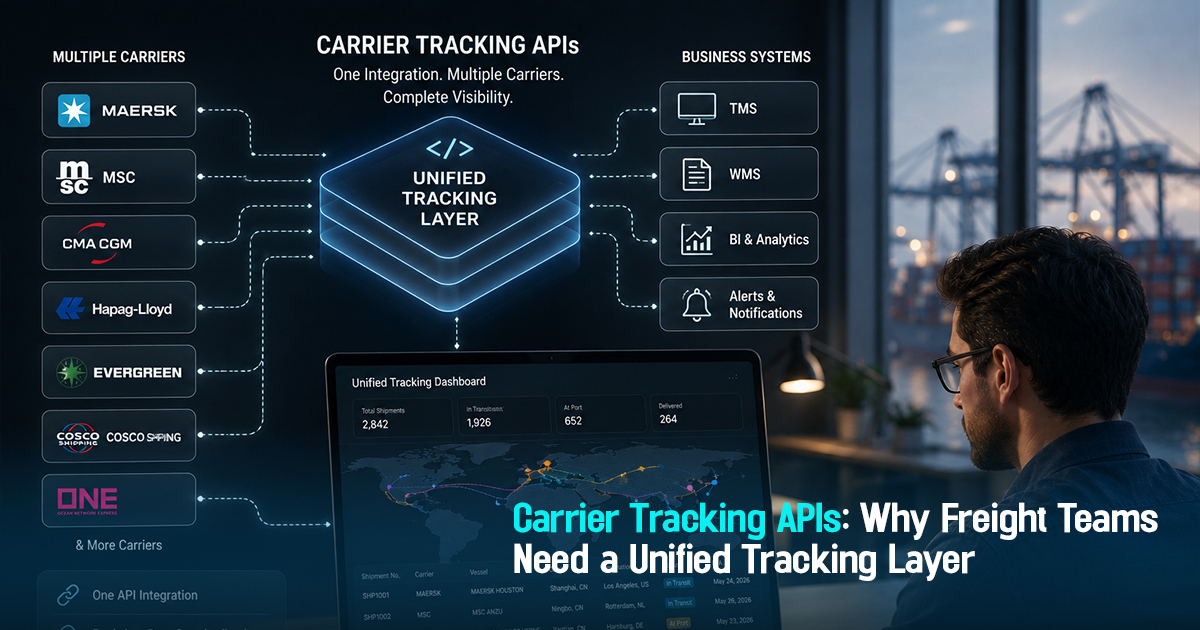
Carrier tracking APIs enable freight teams to gather real-time status updates from multiple carriers through a unified shipment tracking layer. This centralized tracking is critical operationally because it addresses common challenges like fragmented visibility, delayed ETA updates, and inefficient carrier follow-ups. Freight operations often suffer from manual tracking across different carrier portals, resulting in missed exceptions and poor customer communication. This article explores the practical benefits of using carrier tracking APIs as a foundation for unified shipment visibility, structured exception handling, and streamlined operations.
What are Carrier Tracking APIs and Why They Matter
Carrier tracking APIs are application programming interfaces provided by carriers that supply status updates and milestone events for shipments. Through these APIs, freight teams can automate real-time data collection directly into their systems without manual intervention.
Operationally, using carrier tracking APIs reduces reliance on multiple portals and spreadsheets, which often lead to data fragmentation and delayed responses. A unified tracking layer built on these APIs drives consistent milestone monitoring and proactive exception handling across all carriers and transport modes.

A Practical Workflow Framework for Unified Shipment Visibility
Implementing a carrier tracking API-based unified tracking layer follows a structured workflow:
- Carrier API Integration: Connect with multiple carrier APIs to collect shipment status updates and milestone events automatically.
- Centralized Data Aggregation: Normalize data from diverse carriers into a standard format within a centralized platform.
- Milestone and ETA Monitoring: Track expected time of departure (ETD), expected time of arrival (ETA), and transit milestones to flag deviations early.
- Exception Detection and Ownership: Identify delays, missing milestones, or anomalies, and assign clear owners for follow-up.
- Customer Communication: Generate timely updates based on exception signals and milestone changes to keep customers informed.
- Documentation and Compliance Checks: Link shipment status with document workflows to ensure customs clearance and audit readiness.
- Performance Review and Audit: Use historical data to analyze carrier reliability and shipment execution for continuous improvement.
Each step enhances operational clarity, reduces manual errors, and supports faster decisions. For example, connecting all ocean, air, and trucking carriers into one monitoring layer prevents delays caused by missed ETA updates or overlooked exceptions.
Why Freight Teams Struggle Without a Unified Tracking Layer
Multiple carrier portals and manual status checks result in fragmented shipment data and slow response to disruptions. Freight forwarders often waste hours chasing carriers, while importers and exporters receive delayed or inconsistent updates.
For instance, an importer relying on emailed status updates might miss a transshipment delay because no system alerts were triggered. Similarly, operations teams dependent on spreadsheets face challenges reconciling data from ocean and air shipments simultaneously. This inefficiency contributes to missed deadlines, detention costs, and strained customer relations.
Role-Wise Implications of Using Carrier Tracking APIs
Freight forwarders benefit by automating milestone collection, reducing manual carrier follow-ups, and improving exception ownership clarity. APIs enable better coordination between carriers and vendors within a single platform.
Importers and exporters gain timely visibility on shipment ETAs and exceptions, empowering proactive planning for customs clearance and delivery. They can also reduce demurrage and detention risks by acting on real-time alerts.
Operations teams streamline their daily tracking processes by accessing a centralized freight tracking layer that consolidates multiple carriers and modes. This cuts down on fragmented communication and improves exception resolution time.
Procurement and documentation teams leverage API-enabled shipment visibility to validate vendor performance against promised transit times and ensure document handoffs are synchronized with shipment milestones, preventing clearance delays.
Process-Wise Shipment Stage Breakdown with Carrier Tracking APIs
Pre-shipment: Validate booking details and confirm carrier API integration for tracking your transport lanes before shipment initiation.
In-transit: Monitor real-time status updates from all carriers through APIs, track ETA/ETD, and detect exceptions early. Assign ownership for delays.
Customs clearance: Cross-link shipment status with documentation to trigger compliance checks and customs release workflows promptly.
Delivery & post-delivery: Track delivery milestone confirmation and close shipment exceptions to generate performance reports and identify recurrent bottlenecks.
Concrete Freight Operations Examples
1. A freight forwarder integrated carrier tracking APIs from five ocean carriers and two trucking firms, enabling centralized visibility and reducing manual status updates by 70%, significantly lowering customer follow-up volume.
2. An importer avoided demurrage charges when the unified tracking system flagged a vessel delay in real-time, allowing early rerouting of trucking and customs clearance to prevent yard detention.
3. An operations team discovered that missing ETA updates on transshipment ports caused repeated delays; API integration with carriers covering these hubs resolved visibility gaps and improved on-time delivery metrics.
Practical checklist
A checklist for freight teams implementing carrier tracking APIs:
- Have you integrated APIs from all primary carriers involved in your shipments?
- Are shipment milestones (ETD, ETA) normalized across carriers for consistent tracking?
- Is exception detection automated to flag deviations immediately upon status changes?
- Is there defined ownership for resolving exceptions flagged by the tracking layer?
- Do customer updates trigger automatically based on milestone changes and exceptions?
- Are linkage and workflows between shipment visibility and documentation management established?
- Is historical tracking data reviewed regularly to assess carrier reliability and transit time accuracy?
- Are data integrity checks in place to avoid discrepancies from API integration errors?
- Is monitoring of multimodal shipments (ocean, air, trucking) unified within the same tracking platform?
- Is your team trained to interpret API-sourced data and escalate exceptions promptly?
Unified tracking and timely exception ownership transform shipment visibility into actionable control.
Common mistakes
Mistake 1: Partial API Integration — Connecting APIs for only some carriers causes visibility gaps, forcing manual tracking for others. Fix: Prioritize integrating APIs for all significant carriers and transport modes to consolidate data streams.
Mistake 2: Ignoring Data Normalization — Raw carrier data varies in format and terminology, confusing operations teams. Fix: Implement middleware to standardize tracking events and milestone definitions for uniform monitoring.
Mistake 3: No Exception Ownership — Detecting delays without assigned responsibility leads to unresolved issues. Fix: Assign clear owners for exception follow-ups as soon as deviations are detected via APIs.
Mistake 4: Delayed Customer Communication — Waiting to communicate updates until after exceptions escalate damages trust. Fix: Automate timely customer alerts triggered by real-time milestone changes and exceptions.
Mistake 5: Overlooking Documentation Linkages — Shipment visibility disconnected from document workflows causes customs clearance delays. Fix: Integrate document management with tracking to synchronize handoffs and readiness.

A Frayto-Aligned Workflow for Freight Teams Using Carrier Tracking APIs
Frayto’s operational philosophy supports a workflow beginning with api integration and centralized tracking, then moves through milestone monitoring and exception alerting, followed by carrier coordination and documentation control. This ensures customer updates are timely and audit trails complete. By centralizing shipment visibility, teams eliminate siloed data and repetitive communication.
For example, after booking confirmation, carrier APIs feed real-time shipment status into the system. The operations team tracks ETAs daily, and if a milestone is missed, exception ownership is immediately assigned. Carrier and procurement teams receive alerts to resolve the issue. Concurrently, documentation teams prepare customs files triggered by shipment progress. Customers receive decision-ready updates reducing escalation calls. This coordinated loop improves execution control and operational clarity consistently across every shipment.
FAQs
Get in Touch!
We'll reach out shortly with the info you need. No spam, just a helpful conversation.
Recommended Blogs
Freightstory Technologies Private Limited
A-209, Dynasty Business Park, JB Nagar,
Andheri East, Mumbai- 400059, India


For Exporters & Importers
For Freight Forwarders
© 2026 Frayto. All Rights Reserved.