


Solutions
For Exporters & Importers

For Freight Forwarders and Logistics Service Providers

The Daily Exception Brief: A Simple Habit That Transforms High-Volume Freight Teams


4 Minutes
Most high-volume freight teams face the same recurring challenge: exceptions pile up daily, but without a consistent process to highlight and resolve them promptly, these exceptions quietly erode operational efficiency and inflate costs. The simple habit of a daily freight exception management briefing is often overlooked, yet it is key to transforming how freight forwarders and logistics teams handle shipment irregularities and maintain control over complex workflows.
Understanding the Core of Daily Freight Exception Management
Daily exception briefs focus on consolidating all shipment deviations, delays, or compliance flags into one concise briefing. This provides logistics teams and managers a snapshot of anomalies that require immediate attention. The result is operational clarity, separating routine shipments from those needing escalation.
By implementing a structured review each day, teams can better align freight exception handling efforts with overarching goals such as reducing detention costs or accelerating vendor responses. This approach ensures both real-time awareness and proactive resolution of exceptions instead of reactive firefighting, which is often costly and time-consuming.
Key Components of an Effective Daily Exception Brief
A practical daily exception brief includes tracking all shipment milestones against their estimated times of departure (ETD) and arrival (ETA), validating documentation status, and flagging unresolved vendor or carrier follow-ups. It is essential to highlight exceptions that impact costs, like detention and demurrage, and any compliance gaps.
Collating this data into a clear, prioritized list facilitates focused discussions during briefings. It empowers operations teams with a precise understanding of critical pain points and better equips them to allocate responsibility and resources effectively.

Benefits of Instituting a Daily Freight Exception Management Routine
Consistent exception reporting accelerates problem resolution and reduces costly delays. Teams can identify recurring issues earlier, leading to improved vendor performance and fewer surprises in freight costs.
This structured approach also improves freight operations visibility across departments, keeping management in the loop and enabling smarter decision-making based on real operational data rather than assumptions or after-the-fact incident reports.
Daily exception briefs sharpen focus and prevent small issues from becoming costly delays.
Integrating the Daily Exception Brief into High-Volume Freight Management Workflows
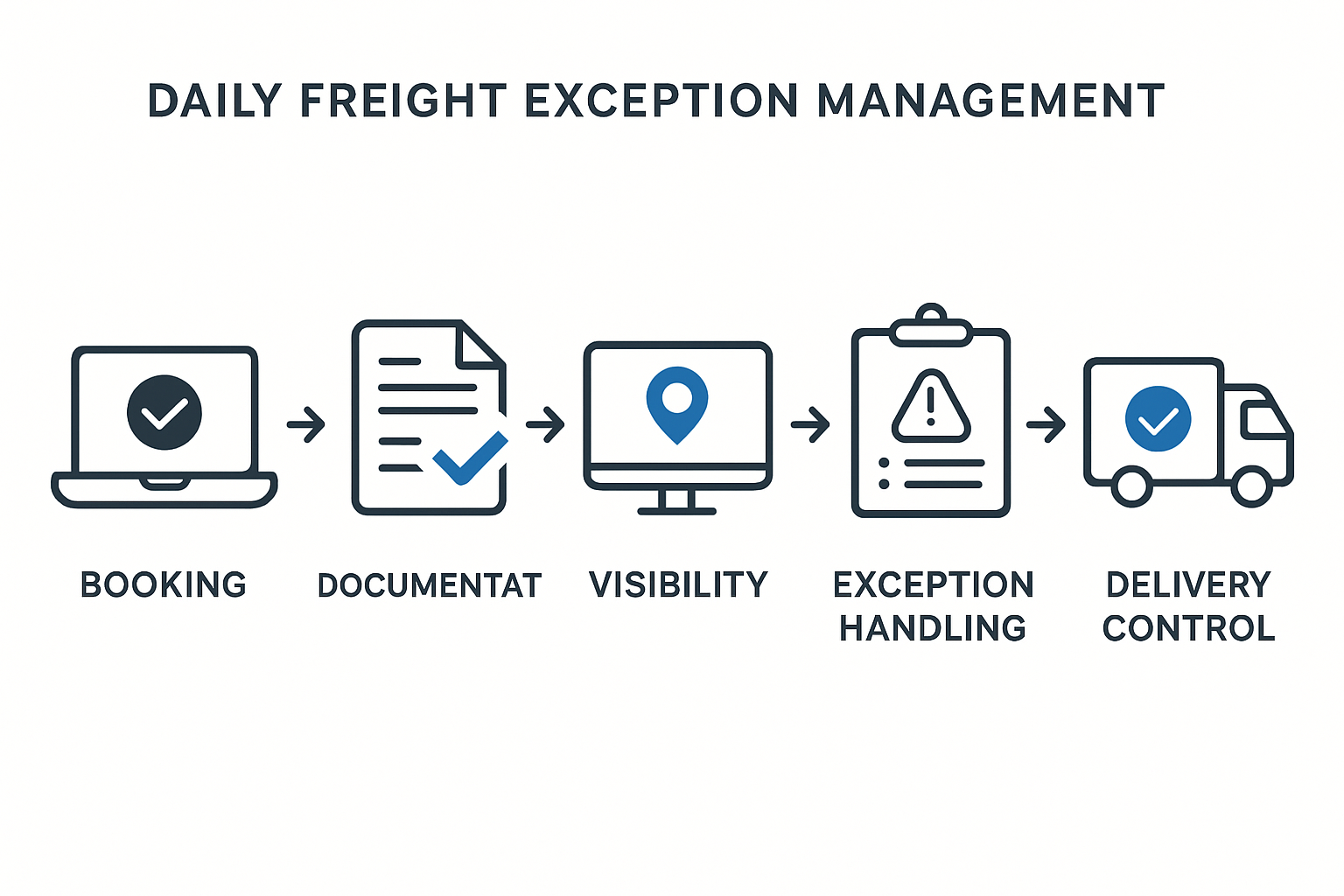
High-volume freight teams must embed exception reviews into their daily cycles, ideally following a workflow like: Booking → Documentation → Visibility → Exception Handling → Delivery Control. Each stage feeds into the daily brief, ensuring no issue slips through unnoticed.
Leveraging digital tools and a centralized freight operations visibility platform can automate exception flagging and data consolidation. This reduces manual workload and allows teams to focus on resolving issues rather than data collection, improving both efficiency and accuracy.
Practical checklist
Before the daily brief: 1) Compile all shipment status updates including ETD and ETA comparisons. 2) Verify all required documents are received and valid. 3) Identify any delays, missing follow-ups, or potential detention risks. 4) Gather vendor and carrier feedback on ongoing exceptions.
During the brief, assign ownership for resolution steps, set deadlines for follow-up, and update exception statuses continuously to maintain ongoing operational discipline. Ensure that insights gained are fed back into procurement and vendor management for continuous improvement.
Common mistakes
A frequent error is treating exception handling as ad hoc, resulting in overlooked or delayed responses. Another is focusing only on high-impact shipments while ignoring smaller but frequent exceptions that cumulatively cause significant friction.
Failing to integrate exception reporting into daily workflows often leads to missed deadlines, poor customer communication, and inflated demurrage costs. Lack of clear ownership and follow-through is also a significant cause of persistent issues.
How to Measure the Impact
Tracking metrics such as average resolution time, reduction in detention/demurrage charges, variance between ETD and actual departure, and vendor responsiveness provides quantitative feedback on the effectiveness of the daily exception brief habit.
Regular reviews of these KPIs drive continuous process improvement and justification for resource allocation to freight exception management activities.
Conclusion
Adopting a daily freight exception management habit is a straightforward but powerful way to enhance operational control in high-volume freight environments. Through structured workflows and disciplined visibility, freight forwarders and operations teams can significantly reduce delays and extra costs while improving vendor coordination and customer communication. By making the daily exception brief a non-negotiable part of freight operations, teams build a culture of accountability and proactive decision-making. This not only limits disruptions but also delivers measurable benefits in terms of compliance and cost control. In an environment where even small exceptions can accumulate into major bottlenecks, maintaining a daily focus on exceptions ensures consistent performance improvements and keeps shipments moving smoothly with clear, reliable operational insight.
References: FIATA, Drewry Shipping Consultants, CBP Customs and Border Protection
Get in Touch!
We'll reach out shortly with the info you need. No spam, just a helpful conversation.



Freightstory Technologies Private Limited
A-209, Dynasty Business Park, JB Nagar,
Andheri East, Mumbai- 400059, India


For Exporters & Importers
For Freight Forwarders
© 2026 Frayto. All Rights Reserved.