


Solutions
For Exporters & Importers

For Freight Forwarders and Logistics Service Providers
How to Reduce Dependency on Individuals in Logistics Operations


5 Minutes
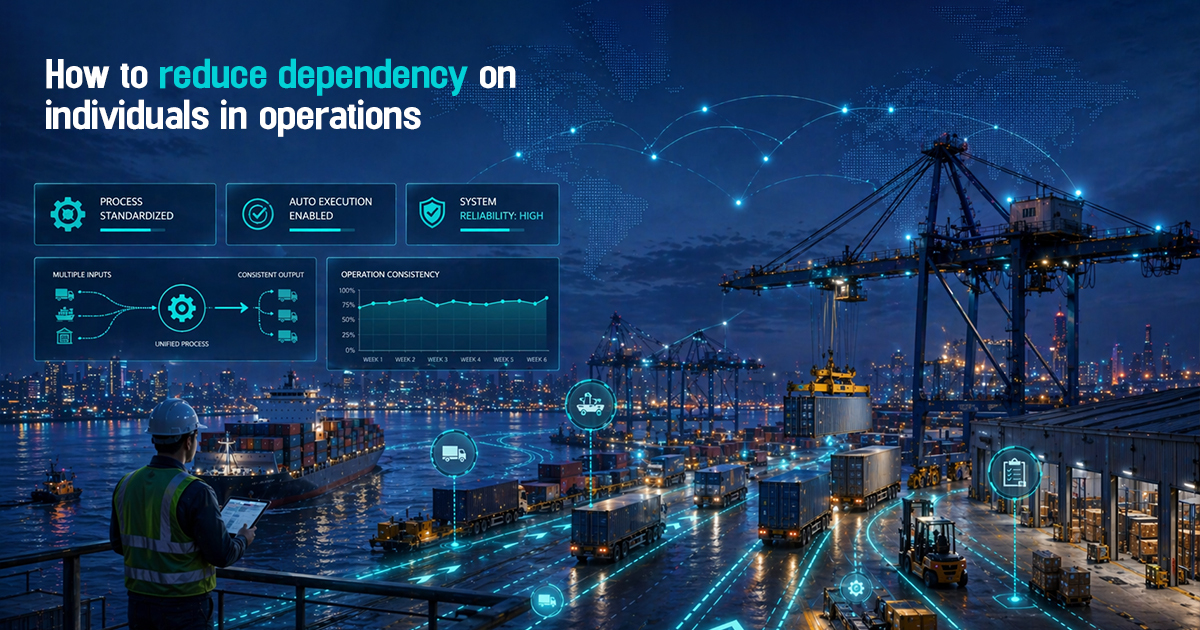
Reducing individual dependency in logistics is a critical focus for operations teams and supply chain managers aiming to enhance resilience and efficiency. When freight operations rely too heavily on single points of contact or key individuals, disruptions such as absence, turnover, or miscommunication can cause costly delays and operational gaps. Addressing this challenge requires deliberate process standardization, workforce management, and technology integration to maintain consistent performance under varying conditions.
What is Reducing Individual Dependency in Logistics?
Reducing individual dependency in logistics refers to the strategic practice of minimizing reliance on specific personnel for critical tasks and knowledge within freight and supply chain workflows. This improves operational resilience by distributing roles, capturing process knowledge, and automating routine functions.
In practical terms, this means building workflows, tools, and documentation that support multiple users and prevent bottlenecks caused by unavailable key staff. It also involves adapting collaboration and communication methods so that critical information is visible and accessible across teams.

Why Reducing Individual Dependency Matters Operationally
Heavy reliance on a few individuals for freight procurement, shipment tracking, or customs compliance creates risk points that affect logistics operational efficiency. When a key operator is unavailable, tasks stall, leading to documentation delays, missed follow-ups, and increased detention or demurrage costs.
Moreover, dependency gaps hinder accurate and timely decision-making, reduce auditability, and limit scalability. In global freight management, where regulatory compliance and shipment visibility are paramount, these weaknesses can rapidly cascade into larger disruptions impacting customer satisfaction and cost control.
Identifying Dependency Risks in Your Logistics Workflow
Recognizing areas with individual dependency requires mapping your logistics processes to pinpoint single points of failure. This often includes manual booking workflows, fragmented communication with vendors, or undocumented customs handling procedures that rely on specialists.
Operational teams should audit the flow from procurement through shipment execution, noting where knowledge is siloed or where exceptions escalate due to lack of shared visibility. These risk areas directly impact logistics risk management and must be addressed to ensure smooth operations.
Key Strategies for Reducing Individual Dependency in Logistics
Standardizing logistics workflows is foundational. Clear, documented procedures enable any team member to perform critical tasks reliably. Combined with logistics process automation, this reduces manual errors and accelerates routine actions.
Leveraging workforce management tools and collaborative platforms enhances communication and task handoffs, especially for remote or global teams. Regular cross-training and knowledge sharing also reduce dependence on specialized roles, making your logistics operations more adaptable under pressure.
Standardized workflows and shared visibility are essential to reducing logistics operational risks.
Practical checklist
Follow these steps to reduce individual dependency efficiently:
- Map your entire logistics workflow to identify single points of failure.
- Document standard operating procedures for all critical tasks.
- Implement logistics process automation for repetitive activities like booking and shipment tracking.
- Use collaboration tools to centralize communication and visibility across teams.
- Cross-train staff to cover multiple roles and share knowledge.
- Monitor exceptions and build exception-handling protocols accessible to the team.
- Review and update procedures regularly to reflect regulatory and operational changes.
Common mistakes
Ignoring documentation or relying on verbal handoffs undermines operational clarity and increases risk. Another frequent error is failing to integrate automated tools at early stages, which leaves workflows vulnerable to delays and human error.
Additionally, inadequate communication during procurement and customs clearance phases often leads to bottlenecks that overburden specific team members. Without structured collaboration and visibility, managing detention, demurrage, and shipment exceptions becomes reactive rather than anticipatory.
Implementing Technology to Support Resilience
Adopting logistics team collaboration tools and centralized freight management platforms serves as a backbone for reducing individual dependency. These technologies enable real-time shipment visibility, automated alerts for exceptions, and audit trails for compliance.
By integrating procurement workflows with systemized tracking and vendor coordination, operations managers gain a comprehensive view that supports proactive decision making. These tools also simplify benchmarking and cost control by providing transparent metrics and vendor performance data.
Balancing Automation and Human Oversight
While automation can reduce manual workload, maintaining skilled human oversight is essential for exception management. Operational resilience in logistics depends on well-defined escalation protocols where automated systems trigger human intervention only when necessary.
This balance ensures that teams are not overwhelmed with routine tasks and can focus on complex compliance checks, vendor negotiations, and customer communications that require judgment, all while minimizing individual bottlenecks.
Comparison: Manual vs Automated Logistics Workflows
Manual workflows depend heavily on individual knowledge and manual communication, which risk delays and errors. In contrast, automated logistics workflows provide standardized, traceable processes that multiple team members can access and manage simultaneously.
Automation reduces paperwork bottlenecks and improves accuracy, but requires initial investment and change management. Manual processes may feel flexible but often lack auditability and resilience under operational stress.
Conclusion
Reducing individual dependency in logistics is an actionable strategy to improve operational resilience, efficiency, and risk management. By standardizing workflows, deploying automation, and fostering team collaboration, freight operations minimize the impact of personnel changes or absences. Establishing clear procedures and using collaboration tools also enhance visibility and accountability across the supply chain. For teams aiming to scale or improve consistency, investing effort into reducing individual dependency creates a more robust foundation that can absorb disruption without costly delays. While technology plays a critical role, success depends equally on disciplined workforce management and continuous process review to keep workflows adaptive to changing trade patterns and regulations. In practice, this balanced approach supports reliable freight procurement, documentation flow, shipment visibility, and vendor coordination, which are essential for modern logistics operations.

Get in Touch!
We'll reach out shortly with the info you need. No spam, just a helpful conversation.
Freightstory Technologies Private Limited
A-209, Dynasty Business Park, JB Nagar,
Andheri East, Mumbai- 400059, India


For Exporters & Importers
For Freight Forwarders
© 2026 Frayto. All Rights Reserved.