


Solutions
For Exporters & Importers

For Freight Forwarders and Logistics Service Providers
HBL Tracking Software: Why Freight Forwarders Need House BL Visibility


7 Minutes
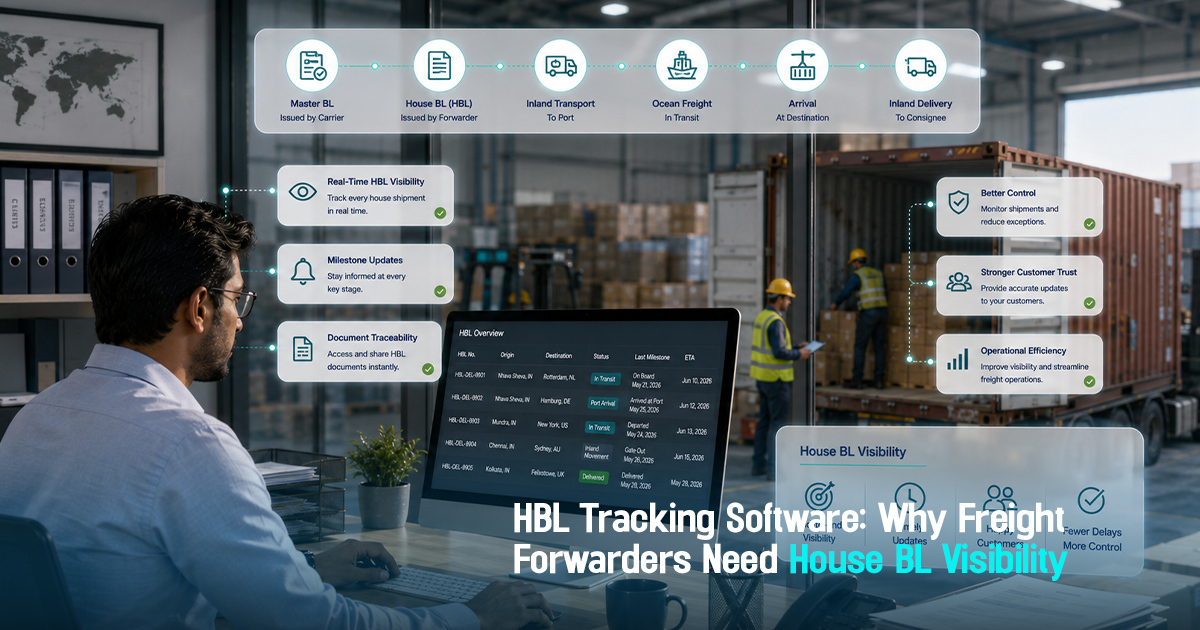
HBL tracking software specifically refers to digital tools that provide visibility into the House Bill of Lading (HBL), a critical freight document issued by freight forwarders for shipments consolidated under a Master Bill of Lading. In freight operations, HBL visibility matters because it directly impacts shipment tracking accuracy, documentation control, and exception management. Without transparent tracking of the house BL, freight forwarders and logistics teams face coordination issues, customer communication gaps, and higher risks of delays and cost overruns. This article dives into why freight forwarders need effective HBL tracking software, practical workflow frameworks to implement it, and actionable checklists to sharpen visibility and control over shipments with house bill documentation.
What is HBL Tracking Software and Why It Matters
HBL tracking software is a digital system that enables freight forwarders to monitor the status, location, and documentation milestones of shipments linked to the House Bill of Lading. The house BL is issued by the freight forwarder to the shipper and consolidates multiple consignments under a carrier Master BL. Visibility into the HBL ensures timely updates across freight milestones and centralizes control over vendor and carrier coordination.
Operationally, missing real-time BL visibility causes fragmented shipment tracking, late exception handling, and customer dissatisfaction. Effective HBL tracking tools bridge gaps between carrier event data and freight forwarder logistics systems, enabling structured procurement, milestone tracking, documentation discipline, and exception management. In consolidated shipments, where multiple suppliers contribute cargo, HBL visibility reduces confusion and ensures compliance and smooth customs clearance.

A Practical Workflow Framework for HBL Tracking Integration
Implementing HBL tracking software within freight operations requires a structured workflow to synchronize shipment visibility and documentation control. Here is a practical 6-step framework tailored for freight forwarders working with house bills:
- 1. HBL Data Capture and Digitization: Collect house BL information promptly from shipping agents and upload it into a centralized system to enable centralized tracking and compliance monitoring.
- 2. Master BL and House BL Reconciliation: Link house BL records with the carrier’s Master BL data to ensure consistency in shipment status and milestones across documents.
- 3. Milestone Tracking and ETA/ETD Monitoring: Monitor key shipment events such as vessel departure, arrival, customs clearance, and last-mile delivery aligned with house BL references.
- 4. Exception Identification and Ownership: Detect delays, documentation gaps, or transshipment exceptions quickly based on HBL data and assign clear responsibility to internal teams or vendors.
- 5. Customer Communication and Updates: Use verified HBL status to proactively inform importers and exporters about shipment progress, deviations, or documentation requests.
- 6. Documentation Handoffs and Compliance Checks: Ensure validated house BL documents are correctly handed off for customs clearance, invoicing, and cargo release while maintaining audit trails.
Integrating these points with your existing cargo tracking software and shipment visibility tools enhances operational clarity and reduces manual interventions significantly.
Role-Wise Responsibilities for HBL Tracking and Visibility
Freight forwarding and logistics operations depend on clear ownership over HBL visibility at different roles to prevent delays and enhance coordination. Roles commonly impacted include:
- Freight Forwarders: Must ensure timely house bill data capture, maintain synchronization with master BLs, and coordinate with carriers and vendors for seamless documentation flow.
- Importers/Exporters: Need access to real-time HBL status for customs preparation, delivery scheduling, and exception queries to avoid last-minute surprises.
- Operations Teams: Should track shipment milestones based on HBL references daily, flag exceptions like late documentation, and coordinate carrier follow-ups systematically.
- Procurement and Documentation Teams: Responsible for validating house bill accuracy, managing handoffs to customs and invoicing, and auditing documentation for compliance and exceptions.
This role-wise clarity ensures faster decision-making and minimizes risks linked to missing or inconsistent HBL visibility.
Implementation Stages of HBL Tracking Software in Freight Operations
Implementing house BL tracking software successfully follows a stage-wise breakdown aligned to freight shipment flow. Consider these stages:
- Pre-Booking Stage: Validate that HBL templates and vendor data capture methods are standardized to facilitate seamless data entry upon booking.
- Booking and Documentation Stage: Upload and verify house BL data against carrier master BLs, ensuring all cargo pieces are accounted for in the digital tracking system.
- In-Transit Stage: Continuously update shipment milestones like vessel loading, sailing, ETA adjustments, and customs checkpoints considering the HBL specifics.
- Arrival and Customs Clearance Stage: Facilitate timely handoff of validated house bills to customs clearance teams and monitor exceptions such as document rejections or compliance queries.
- Delivery and Closure Stage: Confirm final delivery milestones aligned with HBL documentation, close exceptions, and archive records for auditability.
Structured staging streamlines coordination across teams and carriers while making exceptions visible and manageable through the shipment lifecycle.
Three Practical Freight Operations Examples Highlighting HBL Tracking Benefits
Example 1: Missed ETA Update Due to Lack of HBL Visibility - A freight forwarder had the carrier update arrival times only on the master BL system. Without house BL tracking integration, the final consignee was informed late, causing demurrage. Early HBL milestone syncing would have allowed timely customer updates and exception handling.
Example 2: Documentation Delay Prevented by Centralized HBL Tracking - An operations team using a cargo tracking software that included digital house bill of lading management flagged missing signatures on an HBL before cargo arrival, preventing customs clearance delays and avoiding detention fees.
Example 3: Vendor Coordination Streamlined With HBL and Master BL Reconciliation - A freight forwarder handling multiple suppliers consolidated shipments under one master BL but faced cargo misallocation. Using integrated HBL tracking ensured clear cargo ownership and visibility, enabling smooth carrier coordination and dispute resolution.
Clear HBL visibility transforms shipment tracking from reactive to proactive operations.
Practical checklist
Use this checklist to ensure robust HBL tracking and visibility within your freight operations:
- Is your system capturing and centralizing house bill of lading data immediately upon receipt?
- Are master BL and house BL data automatically reconciled for consistency?
- Are shipment milestones explicitly linked to HBL references and tracked in real time?
- Are exceptions like missing documents or delays flagged based on HBL data and assigned an owner?
- Is customer communication tied to verified HBL shipment statuses, not just carrier master BL data?
- Are documentation handoffs, including customs clearances based on house BL, documented and auditable?
- Is ETA/ETD monitoring extended to cover house bill shipments separately where consolidation occurs?
- Are operational teams trained to understand the significance of HBL visibility in exception management?
- Is there a process to regularly audit house BL data accuracy and completeness?
- Are vendor and carrier communications centralized around HBL tracking to prevent siloed information?

Common mistakes
Freight forwarders often encounter operational issues due to poor house bill of lading tracking. Here are common mistakes and practical fixes:
- Mistake: Treating Master BL Tracking as Sufficient Alone - This limits visibility to consolidated shipments ignoring the unique handling of house BL shipments. Fix: Integrate HBL tracking software to link house BL events with master BL data explicitly for full visibility.
- Mistake: Manual, Disjointed Tracking of House Bills - Relying on spreadsheets or email threads causes delays in exceptions being raised. Fix: Adopt centralized cargo tracking tools that automate HBL milestone tracking and exception alerts.
- Mistake: Ignoring Documentation Gaps in HBL before Shipment Arrival - Leads to customs delays and demurrage penalties. Fix: Implement process discipline for early HBL document validation and timely handoffs to customs teams.
- Mistake: Lack of Clear Ownership for HBL Exception Handling - Exceptions remain unresolved due to unclear responsibility. Fix: Assign owners for each HBL-related exception with defined SLA to close the loop.
- Mistake: Inadequate Customer Communication About HBL Status - Causes escalation and trust erosion. Fix: Use verified house BL tracking data to proactively update customers, reducing inquiry volume.
A Frayto-Aligned HBL Tracking Workflow Example
Frayto’s approach to centralized freight visibility lends itself well to structured HBL tracking through this workflow:
- Rate Request & Booking: Freight procurement teams confirm house BL terms during booking for all vendors.
- Documentation Upload & Validation: House BLs are digitized and validated early against carrier master BL data.
- Shipment Tracking & Milestone Updates: Operations teams track milestones linked both to Master and House BLs centrally.
- Exception Identification & Carrier Follow-Up: Delays or documentation gaps detected trigger alerts with assigned owners and automated follow-ups.
- Customer Updates & Document Handoffs: Verified HBL milestones are shared with customers alongside customs handoffs for clearance.
- Audit & Review: Post-delivery audits ensure documentation completeness and vendor performance based on HBL data.
This workflow reinforces shipment visibility, documentation discipline, and accountability, reducing freight delays and misunderstandings.
Get in Touch!
We'll reach out shortly with the info you need. No spam, just a helpful conversation.
Recommended Blogs
Freightstory Technologies Private Limited
A-209, Dynasty Business Park, JB Nagar,
Andheri East, Mumbai- 400059, India


For Exporters & Importers
For Freight Forwarders
© 2026 Frayto. All Rights Reserved.